

Full Print Collection
Please Note: Due to carrier delays, shipping times for print orders may be delayed. We appreciate your understanding.
Featured Prints
Vignettes
2016
Vignettes is a subtle video game that takes on the bold task of transposing the long tradition of the still life into interactive media. As a video game Vignettes performs a task that two-dimensional still life can never do: reveal the interconnectedness of apparently different objects through real-time animation and playful manipulation. Unlike conventional still life, Vignettes creates radical relationships between objects that may not have been there before, instead of meditating on the form of a single object alone. In print form however, these relationships are again refocused on the essence of objects in the manner of still life painting, drawing, and photography, revealing that 3D modeling is an extension of these media and that the video game artist can have it both ways.
Pol Clarissou is a graphist and game developer based in Valenciennes, France. His other credits include noteworthy existential wandering games such as Even the Stars, and Orchids to Dusk: a 2016 Independent Games Festival Nuovo award nominee. He is also a former resident of KO-OP. Vignettes is a collaboration between Clarrisou, Armel Gibson, Pat Ashe, and David Kanaga.
Options:
Poster: $35 - 18 x 24 inch unframed matte poster
White Framed Poster: $85 - 18 x 24 inch white framed matte poster (US shipping only)
Black Framed Poster: $85 - 18 x 24 inch black framed matte poster (US shipping only)
Unframed Giclee: $100 - 18 x 24 inch unframed premium giclee

Kentucky Route Zero
2014
The title Kentucky Route Zero refers to more than a video game. It is more a context for video games, video games that are between other video games, artworks that sometimes are and sometimes are not video games, the negative space that fills gaps between these relationships, and the liminal space at the cusp of video games and everyday life. That context can also be described as a series of stories, a shared context for mystery (rather than puzzles), loss, community, pathos, media art histories, haunted technology, and skeletons. With so many paths within the world of Kentucky Route Zero and so many points of entry it might be hard to know where to start. Simply staring at this iconic cover image for Kentucky Route Zero Act II is as excellent a point of entry (or a point of reflection for those already traveling the Zero) as any.
Cardboard Computer is the collective name of Jake Elliot, Tamas Kemenczy, and Ben Babbit. They are known for their sprawling multi-part video game project Kentucky Route Zero which began in 2013. Other credits include Neighbor, an official selection for 2016 Milan Triennial International Exhibition, and a House in California which was nominated for the 2011 Independent Games Festival Nuovo Award.
Options:
Poster: $35 - 18 x 24 inch unframed matte poster
White Framed Poster: $85 - 18 x 24 inch white framed matte poster (US shipping only)
Black Framed Poster: $85 - 18 x 24 inch black framed matte poster (US shipping only)
Unframed Giclee: $150 - 18 x 24 inch unframed premium giclee

Battle Chef Brigade
2017
Battle Chef Brigade (2017) by Trinket Studios is charming and beguiling. Players fight monsters and use their parts to cook meals in a final competition reminiscent of the television show Iron Chef. Trinket artist Eric Huang drew upon influences Studio Ghibli, Michael Dante DiMartino and Bryan Konietzko’s Avatar: the Last Airbender, and Japanese developer Capcom’s fighting games to realize fast-paced, entertaining monster battle sequences. The animation is responsive, quick, and satisfying. The hand-drawn ink and watercolor aesthetics, distilled from rich referents in entertainment media, when combined with a lighthearted dialogue and story, give the game a fun and pleasing look and feel.
Trinket Studios is a Chicago-based independent game studio comprised of Tom Eastman, Eric Huang and Ben Perez.
Options:
- Poster: $35 - 18 x 24 inch unframed matte poster
- White Framed Poster: $85 - 18 x 24 inch white framed matte poster
- Black Framed Poster: $85 - 18 x 24 inch black framed matte poster

T-Shirts

VGA Reader
book + PDF
Hidden Folks
2016
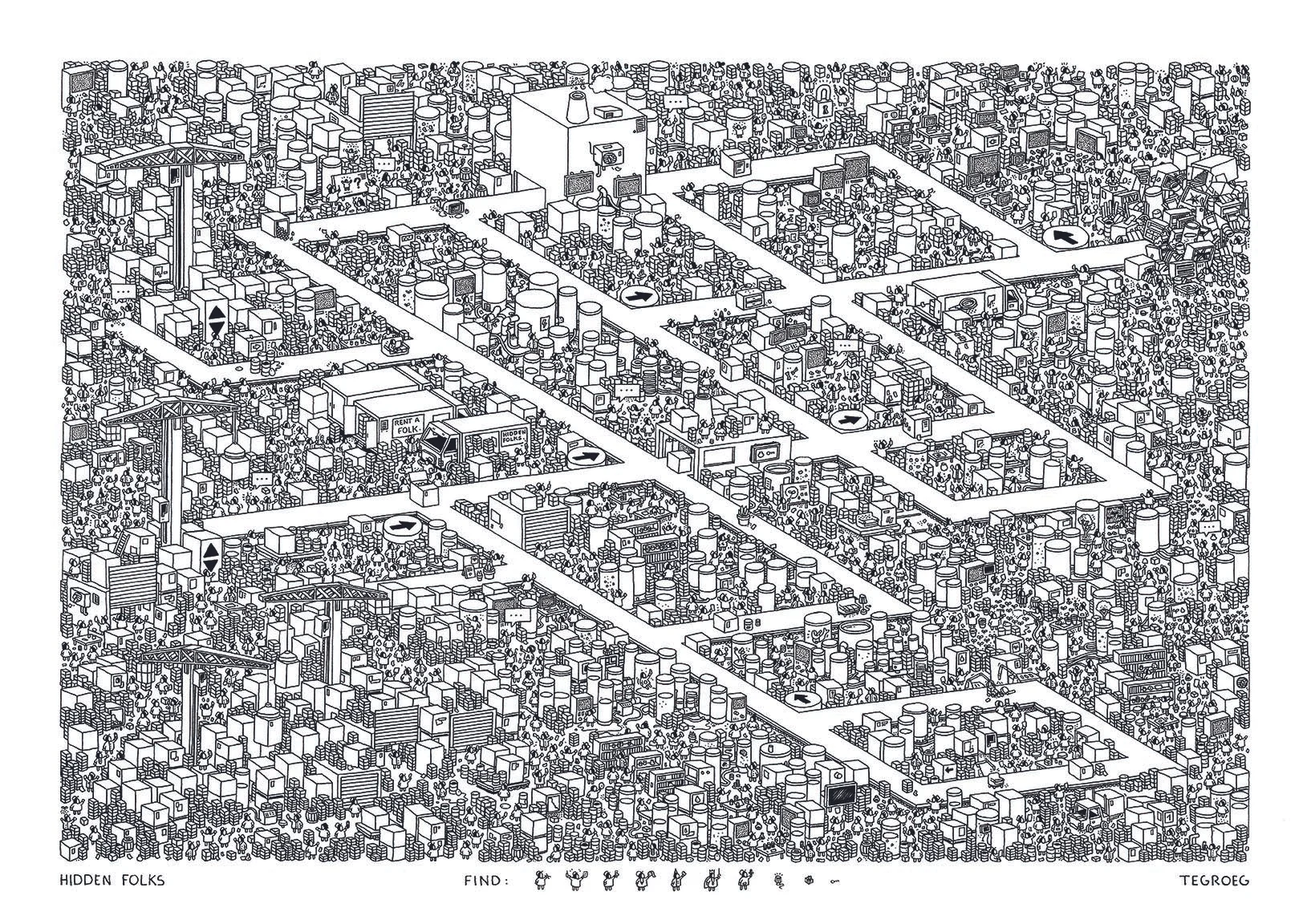
Hidden Folks is a simple game of intricate complexity. The bridge that spans this paradoxical gap is an abundance of captivating, bustling, cartoon humanity that visually distracts and refocuses the player in a constant sequence. Creators Adriaan De Jongh and Sylvain Tegroeg have mentioned the visual similarity between Hidden Folks and Martin Handford's ubiquitous Where's Waldo series of books, but from a wider historical perspective Hidden Folks could be read as a contemporary video game distillation of the collective portraits of Pieter Breugel the Elder's or the overwhelming tableaux vivants of Hieronymus Bosch. Outside of the live video game experience, the overflowing visual detail of hidden folks can function as a game while in print form: this particular scene is complete with a guide (stashed at the bottom of the image) for what individuals and features you should find while gazing at Factory.
Sylvain Tegroeg is a product designer and illustration based in Amsterdam. Hidden Folks is his first collaboration with Adriaan de Jongh, a game designer based in Amsterdam known for such titles as Bounden and Fingle.
Options:
Poster: $35 - 18 x 24 inch unframed matte poster
White Framed Poster: $85 - 18 x 24 inch white framed matte poster (US shipping only)
Black Framed Poster: $85 - 18 x 24 inch black framed matte poster (US shipping only)
Giclee: $75 - 12 x 18 inch unframed premium giclee

Vignettes
2016
Vignettes is a subtle video game that takes on the bold task of transposing the long tradition of the still life into interactive media. As a video game Vignettes performs a task that two-dimensional still life can never do: reveal the interconnectedness of apparently different objects through real-time animation and playful manipulation. Unlike conventional still life, Vignettes creates radical relationships between objects that may not have been there before, instead of meditating on the form of a single object alone. In print form however, these relationships are again refocused on the essence of objects in the manner of still life painting, drawing, and photography, revealing that 3D modeling is an extension of these media and that the video game artist can have it both ways.
Pol Clarissou is a graphist and game developer based in Valenciennes, France. His other credits include noteworthy existential wandering games such as Even the Stars, and Orchids to Dusk: a 2016 Independent Games Festival Nuovo award nominee. He is also a former resident of KO-OP. Vignettes is a collaboration between Clarrisou, Armel Gibson, Pat Ashe, and David Kanaga.
Options:
Poster: $35 - 18 x 24 inch unframed matte poster
White Framed Poster: $85 - 18 x 24 inch white framed matte poster (US shipping only)
Black Framed Poster: $85 - 18 x 24 inch black framed matte poster (US shipping only)
Unframed Giclee: $100 - 18 x 24 inch unframed premium giclee

Vignettes
2016
Vignettes is a subtle video game that takes on the bold task of transposing the long tradition of the still life into interactive media. As a video game Vignettes performs a task that two-dimensional still life can never do: reveal the interconnectedness of apparently different objects through real-time animation and playful manipulation. Unlike conventional still life, Vignettes creates radical relationships between objects that may not have been there before, instead of meditating on the form of a single object alone. In print form however, these relationships are again refocused on the essence of objects in the manner of still life painting, drawing, and photography, revealing that 3D modeling is an extension of these media and that the video game artist can have it both ways.
Pol Clarissou is a graphist and game developer based in Valenciennes, France. His other credits include noteworthy existential wandering games such as Even the Stars, and Orchids to Dusk: a 2016 Independent Games Festival Nuovo award nominee. He is also a former resident of KO-OP. Vignettes is a collaboration between Clarrisou, Armel Gibson, Pat Ashe, and David Kanaga.
Options:
Poster: $35 - 18 x 24 inch unframed matte poster
White Framed Poster: $85 - 18 x 24 inch white framed matte poster (US shipping only)
Black Framed Poster: $85 - 18 x 24 inch black framed matte poster (US shipping only)
Unframed Giclee: $100 - 18 x 24 inch unframed premium giclee

Vignettes
2016
Vignettes is a subtle video game that takes on the bold task of transposing the long tradition of the still life into interactive media. As a video game Vignettes performs a task that two-dimensional still life can never do: reveal the interconnectedness of apparently different objects through real-time animation and playful manipulation. Unlike conventional still life, Vignettes creates radical relationships between objects that may not have been there before, instead of meditating on the form of a single object alone. In print form however, these relationships are again refocused on the essence of objects in the manner of still life painting, drawing, and photography, revealing that 3D modeling is an extension of these media and that the video game artist can have it both ways.
Pol Clarissou is a graphist and game developer based in Valenciennes, France. His other credits include noteworthy existential wandering games such as Even the Stars, and Orchids to Dusk: a 2016 Independent Games Festival Nuovo award nominee. He is also a former resident of KO-OP. Vignettes is a collaboration between Clarrisou, Armel Gibson, Pat Ashe, and David Kanaga.
Options:
Poster: $35 - 18 x 24 inch unframed matte poster
White Framed Poster: $85 - 18 x 24 inch white framed matte poster (US shipping only)
Black Framed Poster: $85 - 18 x 24 inch black framed matte poster (US shipping only)
Unframed Giclee: $100 - 18 x 24 inch unframed premium giclee
Manifold Garden
Manifold Garden is a video game about impossible architecture in imaginary space. This topic refuses immediate categories of explanation, but theoretical models of space are more easily discussed through the video game lens. The game world adds dense visual pleasure as well as the possibility of understanding through participation; two rewards that artist William Chyr offers at the start of the vexing place he begins the conversation.
The architectural forms in Manifold Garden are simultaneously presented as and obscured by alternative models of space. They visually function as a computationally scaled-up version of M.C. Escher’s defiance of 2D and 3D space, but the laws that govern their navigation relate more to the physical cosmology of mathematicians such as Jeffrey R. Weeks. Chyr’s work resolves a three-torus manifold into a space you can inhabit on-screen. Even though the means for negotiating this world, through play or language, may not be immediately available, the struggle through this moment of disorientation is both a game and a reconsideration of space itself.
This series of prints reveals how the interactive space in Manifold Garden functions as a game and as a drawing machine. The artist has selected particular excerpts of the game to generate indeterminate compositions. On screen these compositions are different every time the program is run. As prints they store individual moments of Manifold Garden for prolonged and close consideration; a different vantage point than the ephemeral experience of interacting with the game itself. The individual images that make up this series have been selected through a conversation between Chyr and VGA.
Options:
Poster: $35 - 18 x 24 inch unframed matte poster
White Framed Poster: $85 - 18 x 24 inch white framed matte poster (US shipping only)
Black Framed Poster: $85 - 18 x 24 inch black framed matte poster (US shipping only)
Unframed Giclee: $150 - 18 x 36 inch unframed premium giclee

FOTONICA
In FOTONICA, auteur game studio Santa Ragione reaped huge rewards of intensity from a super-focused study of motion, single-point perspective, and one-button gameplay. Invoking architectural wireframes, aesthetics of 1970’s early computing, and early 20th Century modernist design, FOTONICA can leave a player joyously breathless and exhausted simply from holding the space bar. Players of FOTONICA dash down a single vector into and endless horizon, jumping and landing in order to not fall into a inviting but frustrating void below. Overall, the aesthetic and simple interaction transpose the conventional endless runner into an impossible and irresistible hyper-modern landscape.
Like his work for Santa Ragione’s Mirrormoon EP, Gabriele Brombin’s concept art for FOTONICA blends mid-century science fiction and comic book line drawing into sharp minimalism. Brombin’s geometic spaces and autonomous athletic figures form the visual base of the game’s experience: staying focused and running until the world disappears. Unlike the game, where the perspective is entirely fixed to the runner’s point of view, the FOTONICA prints offer an altogether different perspective: a single moment of the impossibly fast performance is dramatically fixed to the depleting horizon forever. Still, even when time is frozen the figure finds a way to travel outside of its own body and through space. This particular piece, with the appropriately abstract and minimal title 00, measures 22x34 inches unframed and a cropped framed version is also available at 20 x 30 inches.
Options:
Poster: $35 - 18 x 24 inch unframed matte poster
White Framed Poster: $85 18 x 24 inch white framed matte poster (US shipping only)
Black Framed Poster: $85 18 x 24 inch black framed matte poster (US shipping only)
Unframed Giclee: $160 - 22 x 24 inch unframed premium giclee
Framed Giclee: $300 - 20 x 30 inch framed, lightly cropped giclee (US shipping only)

The Banner Saga
Artist Arnie Jorgensen's work in The Banner Saga breathes new life into the distinctive mid-century period of American illustration, as mastered by artists such as Disney Sleeping Beauty artist Eyvind Earle. Cognizant of their two dimensionality, during this period environments and their bushes and trees were flattened. Higher attention was paid to compositional elements such as texture, color and shape rather than pursuit of realistic depictions of the world. The art of The Banner Saga revels in these stylings, while embracing subjects and character rendering found in films such as 1983's Fire and Ice by Ralph Bakshi and Frank Frazetta. Additional influences harken from Jorgensen's days as a Justice League comic book artist, where peers such as Hellboy creator Mike Mignola shaped his work. Breathtaking and epic, sparkling and crisp, the fresh Nordic world of The Banner Saga leaves an unforgettable impression on its fans.
Jorgensen has an artistic background in both comic book and video game industries. From the Justice League to Star Wars: Galaxies and Star Wars: The Old Republic, Jorgensen's affiliations include DC, Malibu and Marvel Comics, Ion Storm, Retro Studios and Sony Online Entertainment. His work was recently recognized with entry into the prestigious 2014 Into the Pixel Collection.
Currently Art Director at Austin's Stoic, Jorgensen formed the game developer in 2012 with fellow veteran game developers Alex Thomas and John Watson. The three hold more than 30 years experience between them in the games industry and all held lead roles on one of the largest projects in gaming history Star Wars: The Old Republic.
Frostvellr is available as part of an edition of 50. It is a 12 x 24 inch image on a 14 x 26 inch paper. A framed, lightly cropped version of this piece is available at 12 x 18 inches. Framed VGA works are printed on an inkjet enhanced matte paper and laminated. The enhanced matte is a heavyweight stock that has a high color gamut that yields remarkable color reproduction. Posters are laminated and mounted to masonite, then secured in a black wooden frame.
Options:
Unframed Matte: $90 - 12 x 24 inch image on 14 x 26 inch paper
Framed Matte: $190 - 12 x 18 inches (lightly cropped) (US shipping only)

Chambara
Crisp black and white geometry with splashes of color is the art style of Chambara, a local multiplayer stealth-deathmatch game where players camouflage themselves with the environment. The word chambara translates to “samurai sword fighting” and gameplay consists of sneaking, searching, and ambushing other players in dramatic, stylish duels. It was developed by Team Ok for a 2014 Dare to be Digital competition, and inspired by Genndy Tartakovsky's Cartoon Network series Samurai Jack. It has received BAFTA and Indiecade awards and distinctions; Team ok is comprised of Alec Faulkner, Esteban Fajardo, Catherine Fox, Tommy Hoffmann, Kevin Wong, and Austin DeVries.
This sleek design was created by Catherine Fox, an artist and game developer living and working in Los Angeles, California.
Options:
Poster: $35 - 18 x 24 inch unframed matte poster
White Framed Poster: $85 - 18 x 24 inch white framed matte poster (US shipping only)
Black Framed Poster: $85 - 18 x 24 inch black framed matte poster (US shipping only)
Unframed Giclee: $50 - 11 x 17 inch unframed premium giclee
Framed Giclee: $150 - 12 x 18 inches (US shipping only)

Manifold Garden
Manifold Garden is a video game about impossible architecture in imaginary space. This topic refuses immediate categories of explanation, but theoretical models of space are more easily discussed through the video game lens. The game world adds dense visual pleasure as well as the possibility of understanding through participation; two rewards that artist William Chyr offers at the start of the vexing place he begins the conversation.
The architectural forms in Manifold Garden are simultaneously presented as and obscured by alternative models of space. They visually function as a computationally scaled-up version of M.C. Escher’s defiance of 2D and 3D space, but the laws that govern their navigation relate more to the physical cosmology of mathematicians such as Jeffrey R. Weeks. Chyr’s work resolves a three-torus manifold into a space you can inhabit on-screen. Even though the means for negotiating this world, through play or language, may not be immediately available, the struggle through this moment of disorientation is both a game and a reconsideration of space itself.
This series of prints reveals how the interactive space in Manifold Garden functions as a game and as a drawing machine. The artist has selected particular excerpts of the game to generate indeterminate compositions. On screen these compositions are different every time the program is run. As prints they store individual moments of Manifold Garden for prolonged and close consideration; a different vantage point than the ephemeral experience of interacting with the game itself. The individual images that make up this series have been selected through a conversation between Chyr and VGA.
Options:
Poster: $35 - 18 x 24 inch unframed matte poster
White Framed Poster: $85 - 18 x 24 inch white framed matte poster (US shipping only)
Black Framed Poster: $85 - 18 x 24 inch black framed matte poster (US shipping only)
Unframed Giclee: $150 - 18 x 36 inch unframed premium giclee

Gardenarium
Paloma Dawkins, Kyler Kelly, and Ylang Ylang released Gardenarium in 2015 with the support of KO-OP, and connected contemporary experiments in video games to animation traditions rarely attempted by the medium. The visually overflowing first-person exploration game channels late 1960’s and early 1970’s psychedelic animation such as George Dunning’s Yellow Submarine, or Fred Wolf’s feature for Harry Nilson’s The Point! Paloma Dawkins repurposes these styles through the language of zines and digital animation to generously present a complicated stylistic history as an inviting cloud-based place to inhabit. Here in Pearl, we get a close look at the fauna native to the world of Gardenarium, including the amorphously shaped dog companion, featured on the left, familiar to those who have already explored the cloud and met it’s denizens. The two creatures featured in the work are emblematic of Dawkins’ balance between elegance, absurdity, and fantasy. This is a smaller format piece which measures at 8x10 inches.
Paloma Dawkins is an animator, illustrator, and game artist who has done for work the National Film Board of Canada, Epic Meal Time, Paul Galvin, Booya Videos, Deadmau5 and Imogen Heap.
Options:
Poster: $35 - 18 x 24 inch unframed matte poster
White Framed Poster: $85 - 18 x 24 inch white framed matte poster (US shipping only)
Black Framed Poster: $85 - 18 x 24 inch black framed matte poster (US shipping only)
Unframed Giclee: $135 - 8 x 10 inch premium giclee
Framed Giclee: $135 - 8 x 10 inch premium giclee
Mirrormoon, Day: The Pillars
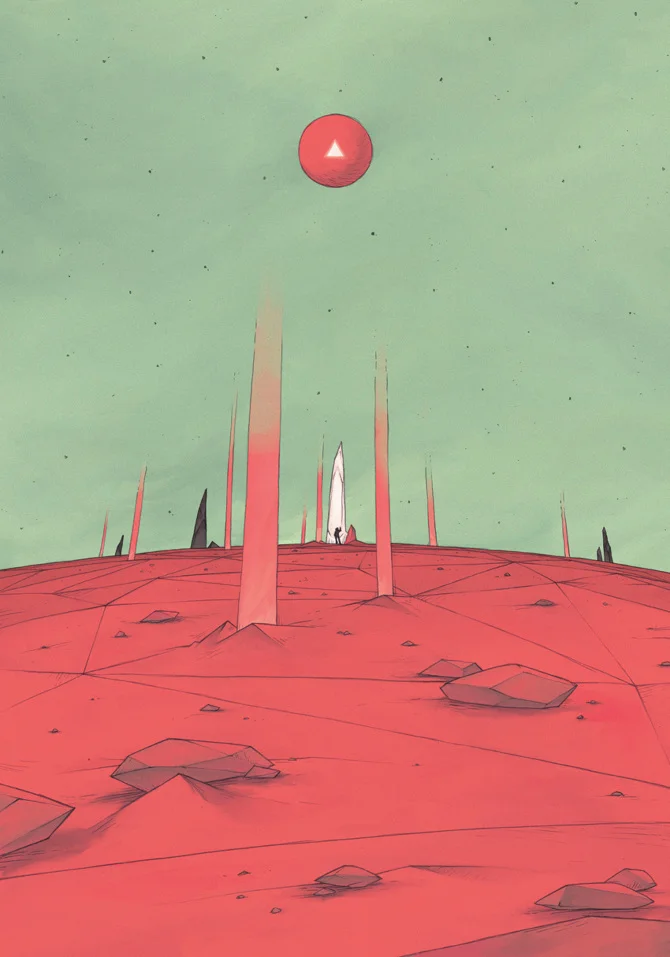
Santa Ragione has established an new vocabulary of space and tone in the first-person puzzler genre with Mirrormoon EP. Gabriele Brombin's concept art for the existentially haunting yet pastoral moonscapes explored in the game brings together science fiction, abstraction, and comic book style. As one part of a diptych, Mirrormoon, Day: The Pillars plays with positive and negative space in a manner similar to how the player of the game must navigate using a reflection of their own space. This is a full size format piece which measures at 28'' x 20''.
Options:
Poster: $35 18 x 24 inch unframed matte poster
White Framed Poster: $85 - 18 x 24 inch white framed matte poster (US shipping only)
Black Framed Poster: $85 - 18 x 24 inch black framed matte poster (US shipping only)
Unframed Giclee: $150 - 20 x 28 inch unframed premium giclee
Framed Giclee: $320 - 20 x 30 inches (US shipping only)

Manifold Garden
Manifold Garden is a video game about impossible architecture in imaginary space. This topic refuses immediate categories of explanation, but theoretical models of space are more easily discussed through the video game lens. The game world adds dense visual pleasure as well as the possibility of understanding through participation; two rewards that artist William Chyr offers at the start of the vexing place he begins the conversation.
The architectural forms in Manifold Garden are simultaneously presented as and obscured by alternative models of space. They visually function as a computationally scaled-up version of M.C. Escher’s defiance of 2D and 3D space, but the laws that govern their navigation relate more to the physical cosmology of mathematicians such as Jeffrey R. Weeks. Chyr’s work resolves a three-torus manifold into a space you can inhabit on-screen. Even though the means for negotiating this world, through play or language, may not be immediately available, the struggle through this moment of disorientation is both a game and a reconsideration of space itself.
This series of prints reveals how the interactive space in Manifold Garden functions as a game and as a drawing machine. The artist has selected particular excerpts of the game to generate indeterminate compositions. On screen these compositions are different every time the program is run. As prints they store individual moments of Manifold Garden for prolonged and close consideration; a different vantage point than the ephemeral experience of interacting with the game itself. The individual images that make up this series have been selected through a conversation between Chyr and VGA.
VGA posters have a matte finish on acid-free #80 coated cover stock. They are all 18 x 24 inches and open editioned and include a choice between black and white frames.
Options:
Poster: $35 - 18 x 24 inch unframed matte poster
White Framed Poster: $85 - 18 x 24 inch white framed matte poster (US shipping only)
Black Framed Poster: $85 - 18 x 24 inch black framed matte poster (US shipping only)
Unframed Giclee: $150 - 18 x 36 inch unframed premium giclee

Manifold Garden
Manifold Garden is a video game about impossible architecture in imaginary space. This topic refuses immediate categories of explanation, but theoretical models of space are more easily discussed through the video game lens. The game world adds dense visual pleasure as well as the possibility of understanding through participation; two rewards that artist William Chyr offers at the start of the vexing place he begins the conversation.
The architectural forms in Manifold Garden are simultaneously presented as and obscured by alternative models of space. They visually function as a computationally scaled-up version of M.C. Escher’s defiance of 2D and 3D space, but the laws that govern their navigation relate more to the physical cosmology of mathematicians such as Jeffrey R. Weeks. Chyr’s work resolves a three-torus manifold into a space you can inhabit on-screen. Even though the means for negotiating this world, through play or language, may not be immediately available, the struggle through this moment of disorientation is both a game and a reconsideration of space itself.
This series of prints reveals how the interactive space in Manifold Garden functions as a game and as a drawing machine. The artist has selected particular excerpts of the game to generate indeterminate compositions. On screen these compositions are different every time the program is run. As prints they store individual moments of Manifold Garden for prolonged and close consideration; a different vantage point than the ephemeral experience of interacting with the game itself. The individual images that make up this series have been selected through a conversation between Chyr and VGA.
Options:
Poster: $35 - 18 x 24 inch unframed matte poster
White Framed Poster: $85 - 18 x 24 inch white framed matte poster (US shipping only)
Black Framed Poster: $85 - 18 x 24 inch black framed matte poster (US shipping only)
Unframed Giclee: $150 - 18 x 36 inch unframed premium giclee
Shape of the World
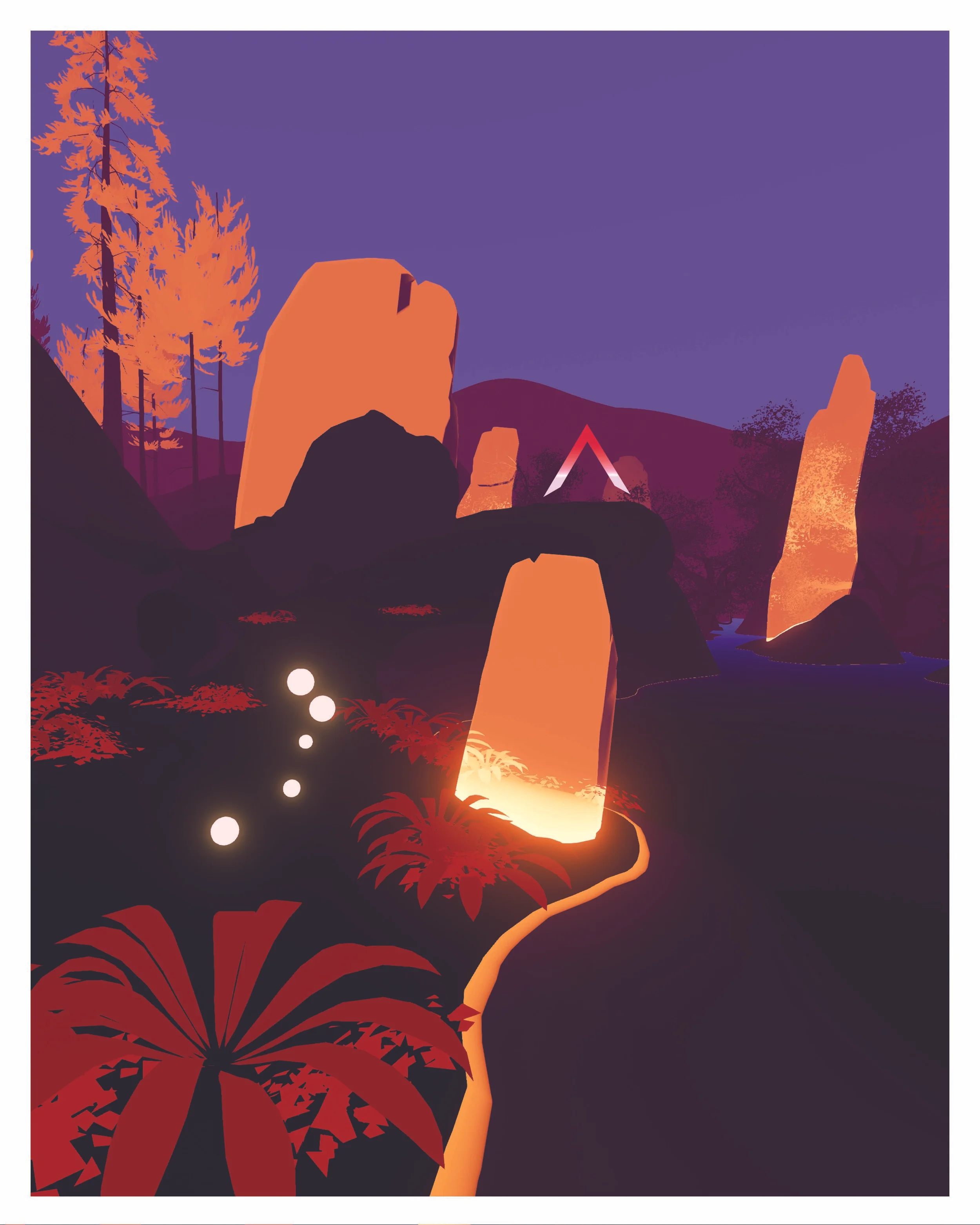
Developed by Hollow Tree Games, Shape of the World (2016) is an ephemeral first-person exploration game where the world grows around you in a procedurally populated environment. Its stated goal is the thrill of getting lost and and the joy finding one’s way again. The gamer’s presence is the driving force behind the evolving environment as you establish permanent monuments to mark your way. It was a funded 2015 kickstarter project and was exhibited at Bit Bash Chicago in 2015.
Testament to the game’s alien beauty, this image is an actual screenshot. The world is warped and abstracted, with geometric shapes interspersed throughout a dayglow flora.
Hollow Tree Games is based in Vancouver, Canada, and is comprised of Stu Maxwell, Athomas Goldberg, and Brent Silk.
Options:
Poster: $35 - 18 x 24 inch unframed matte poster
White Framed Poster: $85 - 18 x 24 inch white framed matte poster (US shipping only)
Black Framed Poster: $85 - 18 x 24 inch black framed matte poster (US shipping only)
Unframed Giclee: $75 - 16 x 20 inch premium giclee
Framed Giclee: $150 - 16 x 20 inches (US shipping only)

Manifold Garden
Manifold Garden is a video game about impossible architecture in imaginary space. This topic refuses immediate categories of explanation, but theoretical models of space are more easily discussed through the video game lens. The game world adds dense visual pleasure as well as the possibility of understanding through participation; two rewards that artist William Chyr offers at the start of the vexing place he begins the conversation.
The architectural forms in Manifold Garden are simultaneously presented as and obscured by alternative models of space. They visually function as a computationally scaled-up version of M.C. Escher’s defiance of 2D and 3D space, but the laws that govern their navigation relate more to the physical cosmology of mathematicians such as Jeffrey R. Weeks. Chyr’s work resolves a three-torus manifold into a space you can inhabit on-screen. Even though the means for negotiating this world, through play or language, may not be immediately available, the struggle through this moment of disorientation is both a game and a reconsideration of space itself.
This series of prints reveals how the interactive space in Manifold Garden functions as a game and as a drawing machine. The artist has selected particular excerpts of the game to generate indeterminate compositions. On screen these compositions are different every time the program is run. As prints they store individual moments of Manifold Garden for prolonged and close consideration; a different vantage point than the ephemeral experience of interacting with the game itself. The individual images that make up this series have been selected through a conversation between Chyr and VGA.
Options:
Poster: $35 - 18 x 24 inch unframed matte poster
White Framed Poster: $85 - 18 x 24 inch white framed matte poster (US shipping only)
Black Framed Poster: $85 - 18 x 24 inch black framed matte poster (US shipping only)
Unframed Giclee: $150 - 18 x 36 inch unframed premium giclee

Manifold Garden
Manifold Garden is a video game about impossible architecture in imaginary space. This topic refuses immediate categories of explanation, but theoretical models of space are more easily discussed through the video game lens. The game world adds dense visual pleasure as well as the possibility of understanding through participation; two rewards that artist William Chyr offers at the start of the vexing place he begins the conversation.
The architectural forms in Manifold Garden are simultaneously presented as and obscured by alternative models of space. They visually function as a computationally scaled-up version of M.C. Escher’s defiance of 2D and 3D space, but the laws that govern their navigation relate more to the physical cosmology of mathematicians such as Jeffrey R. Weeks. Chyr’s work resolves a three-torus manifold into a space you can inhabit on-screen. Even though the means for negotiating this world, through play or language, may not be immediately available, the struggle through this moment of disorientation is both a game and a reconsideration of space itself.
This series of prints reveals how the interactive space in Manifold Garden functions as a game and as a drawing machine. The artist has selected particular excerpts of the game to generate indeterminate compositions. On screen these compositions are different every time the program is run. As prints they store individual moments of Manifold Garden for prolonged and close consideration; a different vantage point than the ephemeral experience of interacting with the game itself. The individual images that make up this series have been selected through a conversation between Chyr and VGA.
Options:
Poster: $35 - 18 x 24 inch unframed matte poster
White Framed Poster: $85 - 18 x 24 inch white framed matte poster (US shipping only)
Black Framed Poster: $85 - 18 x 24 inch black framed matte poster (US shipping only)
Unframed Giclee: $150 - 18 x 36 inch unframed premium giclee

FOTONICA
In FOTONICA, auteur game studio Santa Ragione reaped huge rewards of intensity from a super-focused study of motion, single-point perspective, and one-button gameplay. Invoking architectural wireframes, aesthetics of 1970’s early computing, and early 20th Century modernist design, FOTONICA can leave a player joyously breathless and exhausted simply from holding the space bar. Players of FOTONICA dash down a single vector into and endless horizon, jumping and landing in order to not fall into a inviting but frustrating void below. Overall, the aesthetic and simple interaction transpose the conventional endless runner into an impossible and irresistible hyper-modern landscape.
Like his work for Santa Ragione’s Mirrormoon EP, Gabriele Brombin’s concept art for FOTONICA blends mid-century science fiction and comic book line drawing into sharp minimalism. Brombin’s geometic spaces and autonomous athletic figures form the visual base of the game’s experience: staying focused and running until the world disapears. Unlike the game, where the perspective is entirely fixed to the runner’s point of view, the FOTONICA prints allow offer an altogether different perspective: a single moment of the impossibly fast performance is dramatically fixed to the depleting horizon forever. Still, even when time is frozen the figure finds a way to travel outside of its own body and through space. This particular piece, with the appropriately abstract and minimal title 01, measures 21x12 inches unframed and a cropped framed version is also available at 18x12 inches.
Options:
Poster: $35 - 18 x 24 inch unframed matte poster
White Framed Poster: $85 - 18 x 24 inch white framed matte poster (US shipping only)
Black Framed Poster: $85 - 18 x 24 inch black framed matte poster (US shipping only)
Unframed Giclee: $55 - 21 x 12 inch unframed premium giclee
Framed Giclee: $150 - 18 x 12 inch framed, lightly cropped, giclee (US shipping only)

Manifold Garden
Manifold Garden is a video game about impossible architecture in imaginary space. This topic refuses immediate categories of explanation, but theoretical models of space are more easily discussed through the video game lens. The game world adds dense visual pleasure as well as the possibility of understanding through participation; two rewards that artist William Chyr offers at the start of the vexing place he begins the conversation.
The architectural forms in Manifold Garden are simultaneously presented as and obscured by alternative models of space. They visually function as a computationally scaled-up version of M.C. Escher’s defiance of 2D and 3D space, but the laws that govern their navigation relate more to the physical cosmology of mathematicians such as Jeffrey R. Weeks. Chyr’s work resolves a three-torus manifold into a space you can inhabit on-screen. Even though the means for negotiating this world, through play or language, may not be immediately available, the struggle through this moment of disorientation is both a game and a reconsideration of space itself.
This series of prints reveals how the interactive space in Manifold Garden functions as a game and as a drawing machine. The artist has selected particular excerpts of the game to generate indeterminate compositions. On screen these compositions are different every time the program is run. As prints they store individual moments of Manifold Garden for prolonged and close consideration; a different vantage point than the ephemeral experience of interacting with the game itself. The individual images that make up this series have been selected through a conversation between Chyr and VGA..
Options:
Poster: $35 - 18 x 24 inch unframed matte poster
White Framed Poster: $85 - 18 x 24 inch white framed matte poster (US shipping only)
Black Framed Poster: $85 - 18 x 24 inch black framed matte poster (US shipping only)
Unframed Giclee: $150 - 18 x 36 inch unframed premium giclee

Gardenarium
Paloma Dawkins, Kyler Kelly, and Ylang Ylang released Gardenarium in 2015 with the support of KO-OP, and connected contemporary experiments in video games to animation traditions rarely attempted by the medium. The visually overflowing first-person exploration game channels late 1960’s and early 1970’s psychedelic animation such as George Dunning’s Yellow Submarine, or Fred Wolf’s feature for Harry Nilson’s The Point! Paloma Dawkins repurposes these styles through the language of zines and digital animation to generously present a complicated stylistic history as an inviting cloud-based place to inhabit. Here in Fish the Walking Tree, the character of the same name sits in a reverie as intoxicating and ephemeral as the world of Gardenarium itself. This is a smaller format piece which measures at 8x10 inches.
Paloma Dawkins is an animator, illustrator, and game artist who has done for work the National Film Board of Canada, Epic Meal Time, Paul Galvin, Booya Videos, Deadmau5 and Imogen Heap.
Options:
Poster: $35 - 18 x 24 inch unframed matte poster
White Framed Poster: $85 - 18 x 24 inch white framed matte poster (US shipping only)
Black Framed Poster: $85 - 18 x 24 inch black framed matte poster (US shipping only)
Unframed Giclee: $135 - 8 x 10 inch unframed premium giclee
Framed Giclee: $135 - 8 x 10 inch framed premium giclee

FOTONICA
In FOTONICA, auteur game studio Santa Ragione reaped huge rewards of intensity from a super-focused study of motion, single-point perspective, and one-button gameplay. Invoking architectural wireframes, aesthetics of 1970’s early computing, and early 20th Century modernist design, FOTONICA can leave a player joyously breathless and exhausted simply from holding the space bar. Players of FOTONICA dash down a single vector into and endless horizon, jumping and landing in order to not fall into a inviting but frustrating void below. Overall, the aesthetic and simple interaction transpose the conventional endless runner into a impossible and irresistible hyper-modern landscape.
Like his work for Santa Ragione’s Mirrormoon EP, Gabriele Brombin’s concept art for FOTONICA blends mid-century science fiction and comic book line drawing into sharp minimalism. Brombin’s geometic spaces and autonomous athletic figures form the visual base of the the game’s experience: staying focused and running until the world disapears. Unlike the game, where the perspective is entirely fixed to the runner’s point of view, the FOTONICA prints allow offer an altogether different perspective: a single moment of the impossibly fast performance is dramatically fixed to the depleting horizon forever. Still, even when time is frozen the figure finds a way to travel outside of its own body and through space. This particular piece, with the appropriately abstract and minimal title 02, measures 21x12 inches unframed and a cropped framed version is also available at 18x12 inches.
Options:
Poster: $35 - 18 x 24 inch unframed matte poster
White Framed Poster: $85 - 18 x 24 inch white framed matte poster (US shipping only)
Black Framed Poster: $85 - 18 x 24 inch black framed matte poster (US shipping only)
Unframed Giclee: $55 - 21 x 12 inch unframed premium giclee
Framed Giclee: $150 18 x 12 inch framed, lightly cropped, premium giclee (US shipping only)
Shape of the World
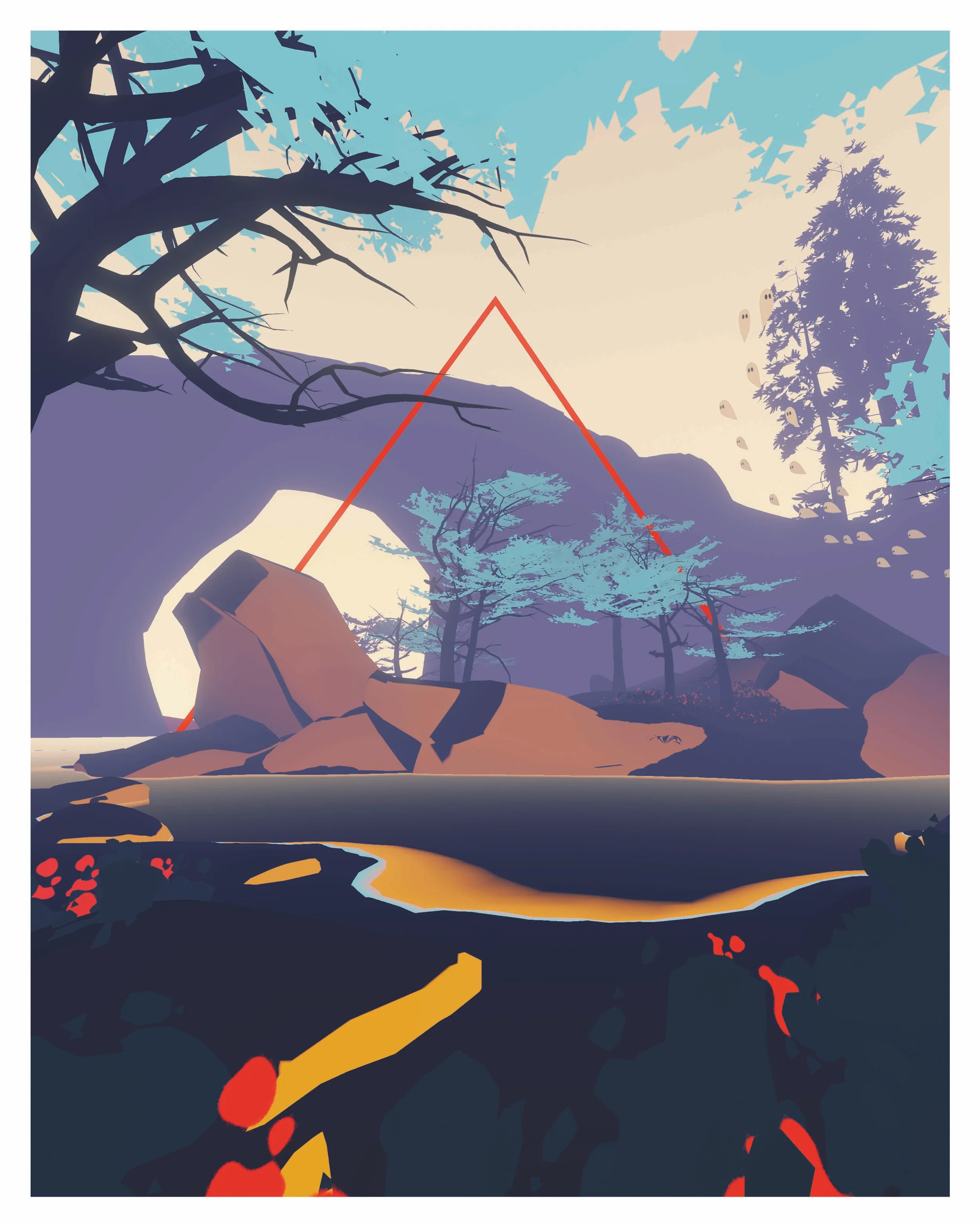
Developed by Hollow Tree Games, Shape of the World (2016) is an ephemeral first-person exploration game where the world grows around you in a procedurally populated environment. Its stated goal is the thrill of getting lost and and the joy finding one’s way again. The gamer’s presence is the driving force behind the evolving environment as you establish permanent monuments to mark your way. It was a funded 2015 kickstarter project and was exhibited at Bit Bash Chicago in 2015.
Testament to the game’s alien beauty, this image is an actual screenshot. The world is warped and abstracted, with geometric shapes interspersed throughout a dayglow flora.
Hollow Tree Games is based in Vancouver, Canada, and is comprised of Stu Maxwell, Athomas Goldberg, and Brent Silk.
Options:
Poster: $35 - 18 x 24 inch unframed matte poster
White Framed Poster: $85 - 18 x 24 inch white framed matte poster (US shipping only)
Black Framed Poster: $85 - 18 x 24 inch black framed matte poster (US shipping only)
Unframed Giclee: $75 - 16 x 20 inch premium giclee
Framed Giclee: $150 - 16 x 20 inches (lightly cropped giclee (US shipping only)

The Banner Saga
Artist Arnie Jorgensen's work in The Banner Saga breathes new life into the distinctive mid-century period of American illustration, as mastered by artists such as Disney Sleepy Beauty artist Eyvind Earle. Cognizant of their two dimensionality, during this period environments and their bushes and trees were flattened. Higher attention was paid to compositional elements such as texture, color and shape rather than pursuit of realistic depictions of the world. The art of The Banner Saga revels in these stylings, while embracing subjects and character rendering found in films such as 1983's Fire and Ice by Ralph Bakshi and Frank Frazetta. Additional influences harken from Jorgensen's days as a Justice League comic book artist, where peers such as Hellboy creator Mike Mignola shaped his work. Breathtaking and epic, sparkling and crisp, the fresh Nordic world of The Banner Saga leaves an unforgettable impression on its fans.
Jorgensen has an artistic background in both comic book and video game industries. From the Justice League to Star Wars: Galaxies and Star Wars: The Old Republic, Jorgensen's affiliations include DC, Malibu and Marvel Comics, Ion Storm, Retro Studios and Sony Online Entertainment. His work was recently recognized with entry into the prestigious 2014 Into the Pixel Collection.
Currently Art Director at Austin's Stoic, Jorgensen formed the game developer in 2012 with fellow veteran game developers Alex Thomas and John Watson. The three hold more than 30 years experience between them in the games industry and all held lead roles on one of the largest projects in gaming history Star Wars: The Old Republic.
Options:
Unframed Matte: $100 - 12 x 24 inch image on 14 x 26 paper
Framed Matte: $200 (lightly cropped): 12 x 18 inches (US shipping only)

Lumino City
2014
Lumino City is a lovingly realized papercraft world where gamers guide a young girl in search of her missing grandfather in a delightful point and click puzzle adventure. With glue, paper and miniature lights and motors, State of Play Games created a 7 foot tall paper world in a London art studio, building on a rich but altogether too sparse history of physical world game sets pioneered by games like the Neverhood in the mid 90s. The game distinguishes itself from others in the genre by its distinct art style and the sheer quality of its sets and seamless post production adaptation to a digital game. The art direction is characterized by a strong chiarascuro lighting effect and photography and video that make incredible use of resolution and in-focus / out-of-focus scenery to enhance gameplay and illustrate the playful yet mysterious tone. Lumino City's sets contend artistically with stop motion animation film precedents like other UK exports such as Wallace and Gromit. Three iconic vignettes from the game are available, reproduced on a smooth surface, heavy weight (230 g, 9.5-mil), neutral white, matte paper engineered for accurate color reproduction that provides high contrast and high resolution output, to accurately reflect the artistic strengths of these stunning game images.
Prints, sketches and video from Lumino City were exhibited at UK-based GameCity game festival and the game has been nominated for awards including the 2014 Independent Games Festival's Excellence in Visual Arts award. Established in 2008, State of Play’s work has won a number of international awards. It is headed by artist, designer and animator Luke Whittaker, who works with a small team that includes co-founder Katherine Bidwell, and developer and technician Daniel Fountain. State of Play is known for its predecessor Lume, winner of a Develop Showcase Award, and KAMI, winner of Mac App Store Best of 2013, and a while back released Headspin: Storybook for iOS platforms, one of Apple’s ‘Best iPad Apps of 2010’. State of Play's clients include other creative industries including MTV, Miniclip, BBC, ESPN, Fremantle, Mind Candy and Shockwave, and animations for the likes of Oxfam, BBC, Christian Aid and Macmillan.
Options:
Poster: $35 18 x 24 inch unframed matte poster
White Framed Poster: $85 18 x 24 inch white framed matte poster (US shipping only)
Black Framed Poster: $85 18 x 24 inch black framed matte poster (US shipping only)
Unframed Giclee: $65 - 11 x 17 inch premium giclee
Framed Giclee: $165 - 18 x 12 inches, lightly cropped giclee (US shipping only)

Sword & Sworcery EP
2011
The advent of Apple's iOS ecosystem created a broad new possibility space for videogame design, and a noted cult classic in this space was 2011's Superbrothers: Sword & Sworcery EP, a future-facing adventure videogame rooted in a mythic past. The project was a showcase for lush woodland landscapes and peculiarly abstracted people and creatures presented with the distinct painterly approach to pixels established over the years by illustrator/creator Superbrothers. Players were invited to guide a wandering warrior monk known the Scythian into the woods, up a mountain, into a dark dungeon and beyond into a rambling shadowy adventure involving dreams, miracles and cryptozoology. As the story progresses the player must push The Scythian to overcome occasional opponents and obstacles despite a deteriorating physical and mental condition in order to reach a strange, complicated, cosmic finale.
Individual trees are Pitfall-like in their simplicity, but taken together the dense, blocky foliage evoke pointilist pastorals. Occasional non-pixel elements - a smoothly gradated sky, soft clouds, clean trigons and a crisp crescent moon - are introduced intentionally. Careful consideration is paid to mood and aesthetics, color palettes of deep forest blues and greens and skies of purple evolve in step with segments of the intentionally forgerounded musical compositions. The project was further distinguished from the videogames of years past with its self aware Twitter-compatible dialogue snippets.
Following its release the project was met with broad critical acclaim, it was selected by Apple as one of five "landmark" videogames in the first five years of the App Store and it was listed in the top 10 videogames of 2011 according to Time Magazine. The release was accompanied by a full length album by Jim Guthrie titled Sword & Sworcery LP: The Ballad of the Space Babies.
Superbrothers was founded in Toronto by illustrator and videogame creator Craig D. Adams in 2003. His artistic influences include Cezanne, Klimt, Hokusai and Hiroshige, comic creator Mike Mignola, as well as the videogames of Shigeru Miyamoto and Nintendo, and early cinema-inspired videogames including Eric Chahi’s Out of This World and Jordan Mechner's Prince of Persia. After studying illustration and videogame design at art schools in and around Toronto, Adams worked for a Japanese videogame company as a concept artist and designer while evolving the Superbrothers style in illustrations for magazines and newspapers and in tiny animated musical films. Superbrothers: Sword & Sworcery features art, concepts and design from Adams, the project was co-created with Toronto videogame studio Capy and it prominently features music from composer Jim Guthrie.
superbrothersHQ.com
@superbrothersHQ
@craigdadams
This print is one of an edition of 50 and comes with a signed certificate of authenticity by the artist. It measures 11 x17.
Options:
Poster: $35 - 18 x 24 inch unframed matte poster
White Framed Poster: $85 - 18 x 24 inch white framed matte poster (US shipping only)
Black Framed Poster: $85 - 18 x 24 inch black framed matte poster (US shipping only)
Unframed Giclee: $145 - 18 x 12 inch premium giclee
Framed Giclee: $250 - 18 x 12 inches, lightly cropped giclee (US shipping only)

Sword & Sworcery EP
2011
The advent of Apple's iOS ecosystem created a broad new possibility space for videogame design, and a noted cult classic in this space was 2011's Superbrothers: Sword & Sworcery EP, a future-facing adventure videogame rooted in a mythic past. The project was a showcase for lush woodland landscapes and peculiarly abstracted people and creatures presented with the distinct painterly approach to pixels established over the years by illustrator/creator Superbrothers. Players were invited to guide a wandering warrior monk known the Scythian into the woods, up a mountain, into a dark dungeon and beyond into a rambling shadowy adventure involving dreams, miracles and cryptozoology. As the story progresses the player must push The Scythian to overcome occasional opponents and obstacles despite a deteriorating physical and mental condition in order to reach a strange, complicated, cosmic finale.
Individual trees are Pitfall-like in their simplicity, but taken together the dense, blocky foliage evoke pointilist pastorals. Occasional non-pixel elements - a smoothly gradated sky, soft clouds, clean trigons and a crisp crescent moon - are introduced intentionally. Careful consideration is paid to mood and aesthetics, color palettes of deep forest blues and greens and skies of purple evolve in step with segments of the intentionally forgerounded musical compositions. The project was further distinguished from the videogames of years past with its self aware Twitter-compatible dialogue snippets.
Following its release the project was met with broad critical acclaim, it was selected by Apple as one of five "landmark" videogames in the first five years of the App Store and it was listed in the top 10 videogames of 2011 according to Time Magazine. The release was accompanied by a full length album by Jim Guthrie titled Sword & Sworcery LP: The Ballad of the Space Babies.
Superbrothers was founded in Toronto by illustrator and videogame creator Craig D. Adams in 2003. His artistic influences include Cezanne, Klimt, Hokusai and Hiroshige, comic creator Mike Mignola, as well as the videogames of Shigeru Miyamoto and Nintendo, and early cinema-inspired videogames including Eric Chahi’s Out of This World and Jordan Mechner's Prince of Persia. After studying illustration and videogame design at art schools in and around Toronto, Adams worked for a Japanese videogame company as a concept artist and designer while evolving the Superbrothers style in illustrations for magazines and newspapers and in tiny animated musical films. Superbrothers: Sword & Sworcery features art, concepts and design from Adams, the project was co-created with Toronto videogame studio Capy and it prominently features music from composer Jim Guthrie. Adams currently lives and works in the woods of Quebec where a new as-yet-unnanounced Superbrothers project is slowly taking shape.
superbrothersHQ.com
@superbrothersHQ
@craigdadams
Options:
Poster: $35 - 18 x 24 inch unframed matte poster
White Framed Poster: $85 - 18 x 24 inch white framed matte poster (US shipping only)
Black Framed Poster: $85 - 18 x 24 inch black framed matte poster (US shipping only)
Unframed Giclee: $145 - 18 x 12 inch premium giclee
Framed Giclee: $250 - 18 x 12 inches, lightly cropped giclee (US shipping only)

The advent of Apple's iOS ecosystem created a broad new possibility space for videogame design, and a noted cult classic in this space was 2011's Superbrothers: Sword & Sworcery EP, a future-facing adventure videogame rooted in a mythic past. The project was a showcase for lush woodland landscapes and peculiarly abstracted people and creatures presented with the distinct painterly approach to pixels established over the years by illustrator/creator Superbrothers. Players were invited to guide a wandering warrior monk known the Scythian into the woods, up a mountain, into a dark dungeon and beyond into a rambling shadowy adventure involving dreams, miracles and cryptozoology. As the story progresses the player must push The Scythian to overcome occasional opponents and obstacles despite a deteriorating physical and mental condition in order to reach a strange, complicated, cosmic finale.
Individual trees are Pitfall-like in their simplicity, but taken together the dense, blocky foliage evoke pointilist pastorals. Occasional non-pixel elements - a smoothly gradated sky, soft clouds, clean trigons and a crisp crescent moon - are introduced intentionally. Careful consideration is paid to mood and aesthetics, color palettes of deep forest blues and greens and skies of purple evolve in step with segments of the intentionally forgerounded musical compositions. The project was further distinguished from the videogames of years past with its self aware Twitter-compatible dialogue snippets.
Following its release the project was met with broad critical acclaim, it was selected by Apple as one of five "landmark" videogames in the first five years of the App Store and it was listed in the top 10 videogames of 2011 according to Time Magazine. The release was accompanied by a full length album by Jim Guthrie titled Sword & Sworcery LP: The Ballad of the Space Babies.
Superbrothers was founded in Toronto by illustrator and videogame creator Craig D. Adams in 2003. His artistic influences include Cezanne, Klimt, Hokusai and Hiroshige, comic creator Mike Mignola, as well as the videogames of Shigeru Miyamoto and Nintendo, and early cinema-inspired videogames including Eric Chahi’s Out of This World and Jordan Mechner's Prince of Persia. After studying illustration and videogame design at art schools in and around Toronto, Adams worked for a Japanese videogame company as a concept artist and designer while evolving the Superbrothers style in illustrations for magazines and newspapers and in tiny animated musical films. Superbrothers: Sword & Sworcery features art, concepts and design from Adams, the project was co-created with Toronto videogame studio Capy and it prominently features music from composer Jim Guthrie. Adams currently lives and works in the woods of Quebec where a new as-yet-unannounced Superbrothers project is slowly taking shape.
superbrothersHQ.com
@superbrothersHQ
@craigdadams
This print is an eye popping 24.3 x 36" image on a 30 x 40 inch giclee paper.

Beau Blyth (aka Teknopants) released Samurai Gunn in 2014 in the wake of a renaissance of pixel-art based fighting games like Towerfall and Nidhogg. Samurai Gunn cleanly distinguishes itself within the genre, mixing Extended Graphics Array-era aesthetics and the pace and dynamics of martial arts film conventions. The combination creates speed and momentary freezes in action that wouldn’t be possible in the XGA-era, yet revels in the character and scenery articulation invoked by the pixel art of the early 1990’s. This silkscreen design for the game by Jesse Tise associates the title with even more histories and styles. The playable warrior Hayao is depicted in a manner that sits somewhere between comix, street art and the Chicago Imagist style.
Jesse Tise is an illustrator and designer based in South Pasadena, CA. He is the author of the comic book Electric Candyland, as well as a number of other comic books and two-dimensional work.
Beau Blyth is a visual artist and game maker who has produced such titles as Samurai Gunn, 0Space, Shoot First, Action Fist, Fish Face, Das Uberleben and the forthcoming Hyper Light Drifter. He is based in Los Angeles, California.
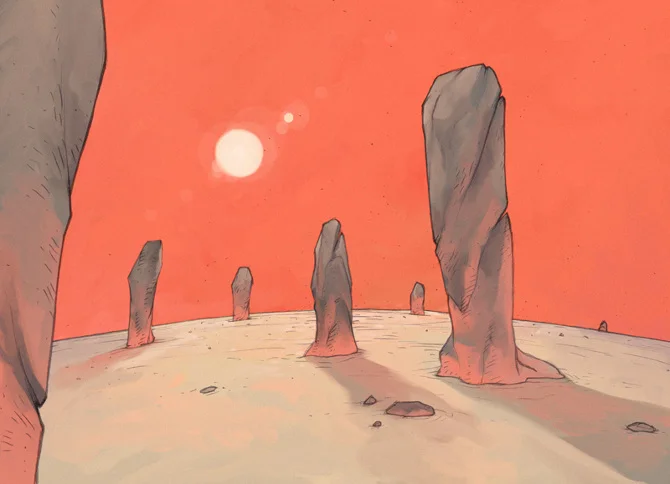
Santa Ragione has established an new vocabulary of space and tone in the first-person puzzler genre with Mirrormoon EP. Gabriele Brombin's concept art for the existentially haunting yet pastoral moonscapes explored in the game brings together science fiction, abstraction, and comic book style. Broken Pillars is possibly the most iconic concept piece for the game for its subject matter's critical importance in the game, but also led the game's visual presence on Steam. This is a smaller format piece which measures at 8x10 inches.
VGA Giclees are printed on a thick (19-mil) heavy weight (310g) paper with the luxurious style of traditional artists' papers. It has a natural-white, matte finish with a textured watercolor feel.
Framed VGA works are printed on an inkjet enhanced matte paper and laminated. The enhanced matte is a heavyweight stock that has a high color gamut that yields remarkable color reproduction. Posters are laminated and mounted to masonite, then secured in a black wooden frame.
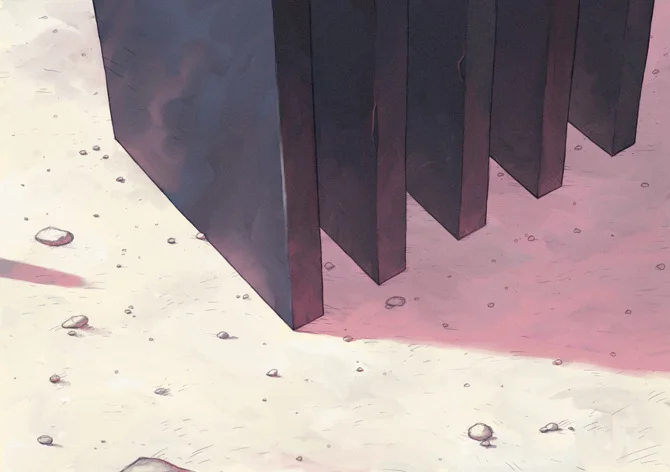
Santa Ragione has established an new vocabulary of space and tone in the first-person puzzler genre with Mirrormoon EP. Gabriele Brombin's concept art for the existentially haunting yet pastoral moonscapes explored in the game brings together science fiction, abstraction, and comic book style. The Passage takes focus on the connection between the structures and the surface of the enigmatic moon; a perspective which is offered in this piece but often eludes the player in the game because of the unique navigation style. This is a smaller format piece which measures at 8'' x 10''.
Hidden Folks
2016
Hidden Folks is a simple game of intricate complexity. The bridge that spans this paradoxical gap is an abundance of captivating, bustling, cartoon humanity that visually distracts and refocuses the player in a constant sequence. Creators Adriaan De Jongh and Sylvain Tegroeg have mentioned the visual similarity between Hidden Folks and Martin Handford's ubiquitous Where's Waldo series of books, but from a wider historical perspective Hidden Folks could be read as a contemporary video game distillation of the collective portraits of Pieter Breugel the Elder's or the overwhelming tableaux vivants of Hieronymus Bosch. Outside of the live video game experience, the overflowing visual detail of hidden folks can function as a game while in print form: this particular scene is complete with a guide (stashed at the bottom of the image) for what individuals and features you should find while gazing at Forest.
Sylvain Tegroeg is a product designer and illustration based in Amsterdam. Hidden Folks is his first collaboration with Adriaan de Jongh, a game designer based in Amsterdam known for such titles as Bounden and Fingle.
Options: